Coffee History

The Story of Coffee
The story of coffee dates back centuries, to the , where legend tells of a shepherd named who noticed his goats becoming unusually energetic after eating red berries from a strange tree. Intrigued, he took some of the berries to a , who brewed them into a drink that helped him stay awake and focused during his nightly prayers.From there, coffee made its way across the , where it became an essential part of life for , helping them remain alert in their moments of worship and reflection. It soon spread across , and by the , reached , evolving from a mysterious local drink into a that brings people together around a single cup.
Coffee, therefore, was never just a simple discovery — it was a , carrying in every sip the story of civilizations, the warmth of human connection, and the timeless aroma of passion and tradition.
The Arabs and Coffee
The relationship between Arabs and coffee is deep and extensive, blending culture, history, and identity, to the point that coffee has become a part of authentic Arab heritage, symbolizing generosity, hospitality, and gatherings. Here is a comprehensive explanation of this relationship from its historical, cultural, and social aspects.

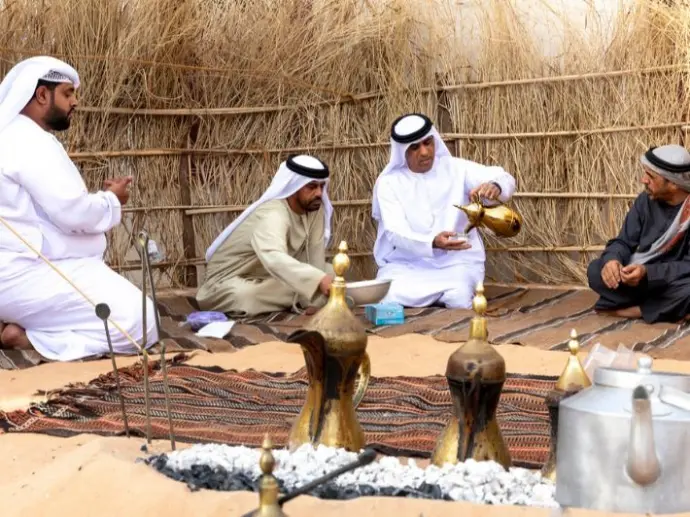
The origin of coffee and its beginnings in the Arab world
It is believed that the origin of coffee was in Yemen in the 15th century, where coffee beans were first roasted and ground to prepare a stimulating drink.
Coffee spread from Yemen to Hijaz, Mecca, and Medina, then to Egypt and the Levant through trade routes and pilgrims.
Initially, it was used by Sufis in Yemen and Hijaz to help them stay awake and engage in remembrance during the night.
From there, it moved to the Arabian Peninsula and then to Istanbul and Europe through Arab and Ottoman traders, until it became a global beverage.
Coffee as a Symbol in Arab Culture
Coffee and Arab Hospitality
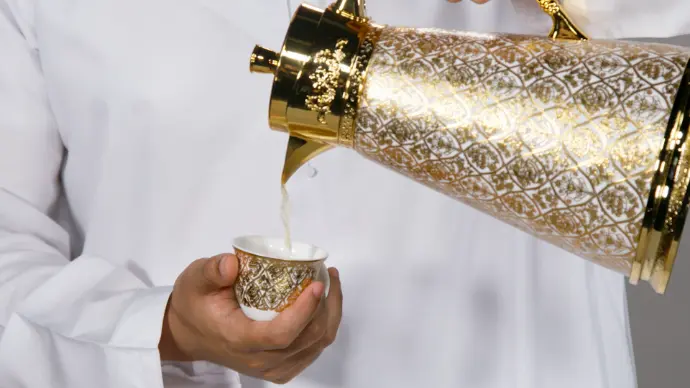
In Arab culture, coffee has always been a symbol of hospitality and generosity; traditional Arabic coffee is served only as a gesture of honor and respect for guests.
An old Arab proverb says:
“Coffee is the adornment of gatherings,”
meaning that it is the mark of warmth, generosity, and welcome.
In the desert, coffee is prepared according to precise and time-honored rituals — the beans are roasted, ground in a mortar, and then boiled in a dallah (Arabic coffee pot). The first cup is always offered to the most respected guest.
The order of serving the cups carries symbolic meaning:
The first is called “Fanjan Al-Haif” — the host drinks it to show the coffee is safe.
The second is “Fanjan Al-Daif” — the guest’s cup.
The third is “Fanjan Al-Kaif” — the cup of enjoyment.
The fourth is “Fanjan Al-Saif” — the cup of alliance or oath, symbolizing loyalty and unity.

Arabic coffee as identity and heritage
Arabic coffee is prepared from lightly roasted beans and is boiled with cardamom and saffron, served in a dallah and small cups.
Its golden or light color distinguishes it from dark Western coffee.
Arabic coffee and the rituals of its serving were registered on UNESCO's list of intangible cultural heritage in 2015 as a shared heritage between Saudi Arabia, the UAE, Qatar, and Oman.
Today, coffee remains an official symbol at national and social events, served at weddings, funerals, and official visits.
Coffee in Religious and Social Life
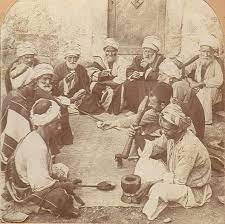
Coffee has helped scholars and mystics stay awake for worship and study.
It has become a symbol of intellectual and literary gatherings, spreading in cafes where cultural discussions were held in Cairo, Damascus, Sana'a, and Mecca since the sixteenth century.
These cafes were the first places for exchanging news and ideas in the Islamic world.